







Drone thermography
for PV systems
As a precise and established analysis method, drone thermography uncovers hidden damage to modules and strings – ensuring secured yields and long-term protection of your investment.
With our photovoltaic thermography, you can identify defects before they become costly
High-resolution drone thermography with AI-supported issues analysis
With our photovoltaic thermography, you secure the performance, safety, and long-term value of your PV system.
Through high-resolution drone imaging and AI-supported thermal analysis, we make issues visible that remain hidden during normal operation and can lead to significant yield losses or safety risks. Our interdisciplinary team of experts evaluates all anomalies according to standards, assigns them to specific modules, and provides concrete recommendations for action along with economic impacts.
This provides you with a reliable basis for repairs, warranty processes, investment decisions, or the sale of your system.

Minimize risks, extend service life, secure yields

Early detection of critical faults
Drone thermography detects hotspots, cell damage, defective strings, and degraded modules long before performance losses become measurable. This allows you to intervene early and avoid costly repairs.

Transparency regarding system condition
You receive a clear, module-specific picture of the technical condition of your PV system – ideal for operation, repowering, warranty processes, or purchase/sale. No assumptions, but reliable facts.

Investment security through sound data and analysis
You receive a comprehensible assessment of the system condition – as a reliable basis for operational and economic decisions. This allows measures to be prioritized, budgets to be deployed strategically, and risks to be transparently documented.

Concrete recommendations for action from interdisciplinary experts
Based on the findings, you receive well-founded assessments and practical measures to secure yields, minimize risks, and extend the service life of your modules. Our PV engineers and operations management experts analyze the results together, identify causes, and evaluate the relevance for operation and profitability.
For every system phase: During commissioning and for optimization of existing systems
Photovoltaic thermography during commissioning
For new ground-mounted PV systems, we use drone thermography to verify that all modules and strings are functioning properly. Hotspots, cell cracks, or faulty connections are detected before the system is commissioned. This ensures full system performance from the outset and establishes a reliable basis for warranty and guarantee processes.
Photovoltaic thermography for existing systems
For existing systems – for example, before purchase or sale, after repowering measures, or as part of operations management – drone thermography serves to establish an objective status quo. It reveals technical weaknesses, performance losses, and potential optimization opportunities. For you, this means: well-founded decision-making bases, investment security, and the ability to initiate targeted measures for yield enhancement or repair.
When is photovoltaic thermography generally advisable?
To verify module performance
With drone thermography, you can identify early whether individual modules or strings exhibit hotspots, cell damage, or defects, even before they lead to yield losses.
To secure service life and preserve value
You identify technical weaknesses in time and can initiate measures to maintain the long-term performance of your system.
For well-founded decisions during purchase or sale
Through drone thermography, you obtain reliable information about the condition of your PV system, helping you evaluate purchase prices or justify sales prices.
To secure warranty claims and maintenance obligations
With precise results from photovoltaic thermography, you can substantiate warranty claims and plan necessary repairs strategically.
For targeted implementation of optimization and repowering measures
You receive a basis for efficiently planning technical adjustments or modernizations of your system to increase yields.
Typical faults we uncover with drone thermography
Drone thermography opens a new perspective on your PV system: It enables rapid, large-scale, and precise detection even of remote module areas that are difficult to access during conventional inspections.
This allows trends in module performance to be identified, potential risks to be detected early, and the condition of the system to be continuously monitored.

Cell damage and hotspots
Cell cracks and cell fractures can lead to inactive cell areas and thus to reduced module performance. Hotspots cause severe thermal stress on the module, resulting in failures or even fire hazards. Performance losses of up to 10% are typical.

Defective cell strings
This occurs due to individual inactive cells, connection faults, or failure of bypass diodes. Inactive cell strings become visible through temperature differences in the series-connected cells within a module. This leads to performance losses of 30 to 60% per module.

Potential-induced degradation
PID is an effect that leads to gradual performance losses, which after several years can amount to 30% or more. In thermographic images, suspicion of PID becomes visible primarily through a checkerboard-like pattern in the edge area of a string.
Our analysis – From data acquisition to actionable results
Data acquisition: Drone flight and high-resolution thermal data
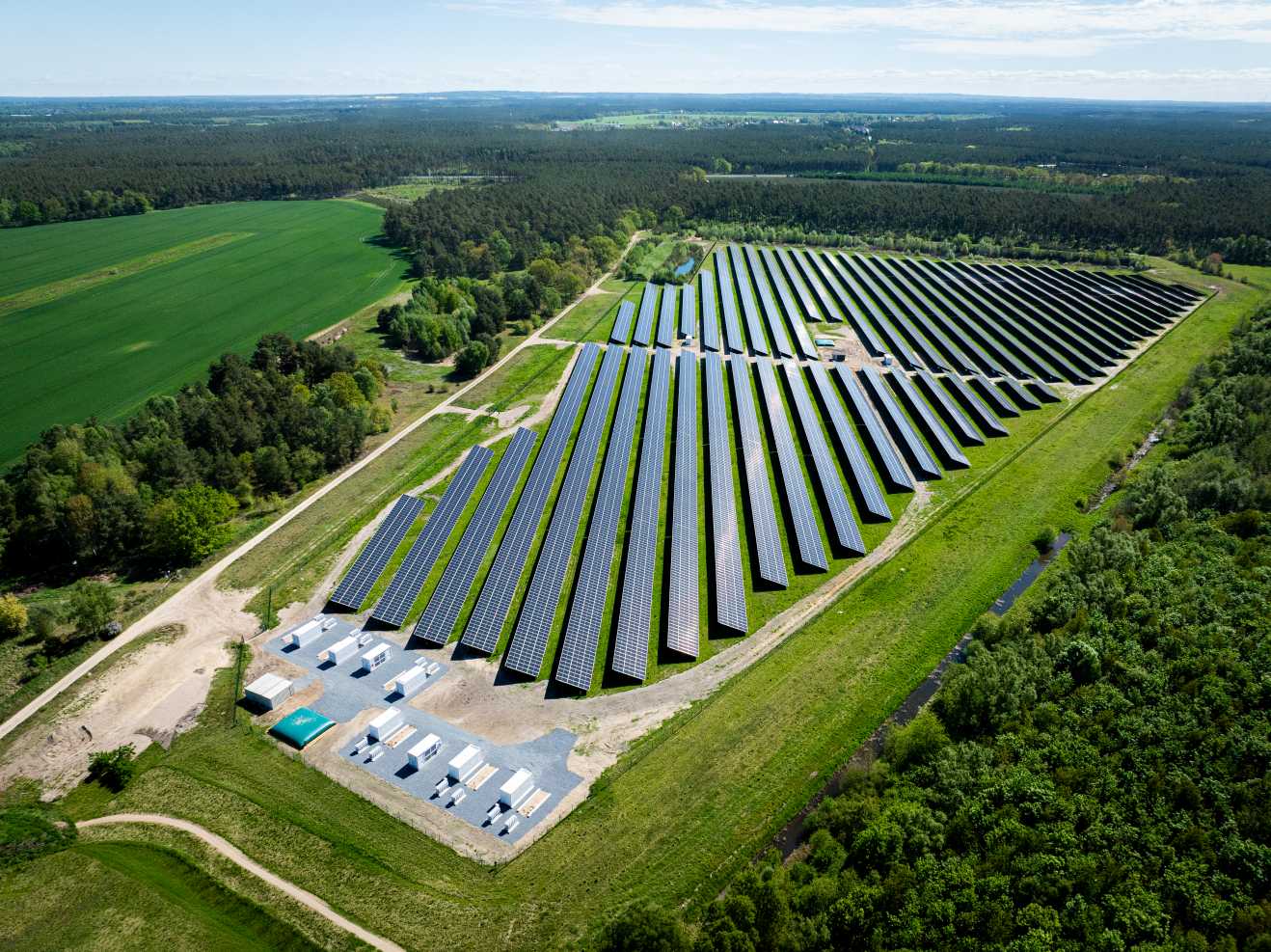
We capture large PV areas quickly, safely, and precisely by drone, creating high-resolution visual (RGB) or thermographic images. The inspection can be performed without shutting down the system for testing—this significantly facilitates implementation, especially for large ground-mounted systems.

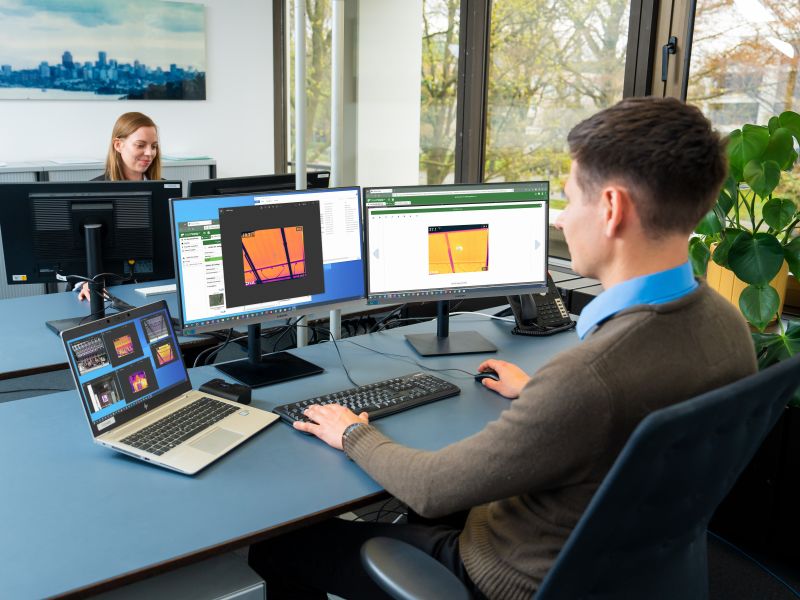
Evaluation: AI-supported analysis & standard-compliant defect classification
The captured data is then evaluated using AI-supported thermal analysis to make visible faults that otherwise remain hidden during normal operation. Anomalies are identified and assessed in accordance with standards (IEC 62446-3:2017) and assigned to specific modules – transforming a thermal image into a reliable technical finding.
Result: Module- and table-specific assignment including structured issues list
You receive a module- and table-specific presentation of the results, allowing findings to be clearly located in the PV field. The presentation includes clear overviews and tabular evaluations, enabling O&M / EPC / asset management to process the results directly in a structured manner.

Drone thermography as part of a Technical Due Diligence
A thermographic inspection can also be a targeted component of a Technical Due Diligence (TDD). It is used to objectively verify the actual technical condition of the system and make visible potential risks that are not apparent in planning documents or documentation.
The results flow directly into the overall assessment and support well-founded decisions, for example during purchase, sale, or financing.

Our service portfolio at a glance
We advise you and support you as an experienced partner with extensive expertise.

Thermographic images

Thermographic imaging of the defined module field
Comprehensive report with all anomalies and sample images
Module-specific representation of all anomalies in an overview plan
Tabular representation with all thermal anomalies in the module field

Analysis and technical solution concept
Analysis and assessment of all thermal anomalies
Presentation of the economic and safety-related impacts of the anomalies
Development of a preliminary concept for repair work, including cost estimate
Calculation of the profitability of repair measures
Documentation and presentation of results
Why work with greentech?

Years of experience

Employees active in 6 European countries

Projects in the development pipeline

Ground-mounted PV systems built

in technical consulting

in operational management
Your specialists for
drone-based photovoltaic thermography

Viola Hoffmann
Commercial Head of Engineering

Johannes Liebich
Head of Engineering & Technical Advisory

Joern Carstensen
Chief Technical Officer (CTO)
In his role, Jörn Carstensen combines the management of all technical areas of the greentech group. As CTO, he is responsible for plant construction, engineering services and technical management. The aim is to create uniform standards and processes across all technical areas at greentech, thereby ensuring company-wide synergies, high quality and the greatest possible transparency.
Jörn Carstensen joined greentech in 2014 as Business Development Manager. In addition to developing various European markets, he built up the Engineering and Technical Advisory division. From 2006 to 2014, he worked for the Conergy Group in various international corporate and business development positions. Prior to that, he worked for a consulting unit of Accenture and supported utility companies in strategic and organisational issues. Jörn Carstensen holds a degree in Industrial Engineering with a specialisation in Energy and Environmental Management from the Universities of Flensburg and Southampton.
Contact
Only 45 seconds for your request
FAQ: Photovoltaic Thermography
Frequently asked questions about drone thermography, fault patterns, and result presentation for ground-mounted PV systems.
What is a thermographic inspection?
Thermography is an infrared analysis method that creates thermal images of your PV system. This makes defects, hotspots, or cell damage visible that are barely detectable with the naked eye. For you, this means: early identification of problems and protection of your investment.
When should I have a thermographic inspection performed?
An inspection using drone thermography is advisable during commissioning of new systems, for monitoring existing modules, before purchase or sale of systems, and as part of warranty or repowering measures. This provides you with reliable information about the condition of your modules and allows you to derive targeted measures.
What faults and anomalies are detected during drone thermography?
Typical results include hotspots, cell cracks, defective cell strings, or suspicion of potential-induced degradation (PID). Through the analysis, you can see exactly where performance losses could occur and take targeted action to secure yields.
How are the inspection results presented?
With drone thermography, we create module- and table-specific evaluations with clear overviews, tabular representations, and recommendations for action. This allows you to know exactly which modules or areas are affected and which measures are appropriate.
What advantages do I have from drone thermography for ground-mounted systems?
Drones enable rapid, safe, and precise capture of large PV areas. This allows us to identify hotspots, cell damage, or other anomalies at the module and table level without shutting down the system for inspections – saving time, minimizing effort, and delivering reliable results for targeted repair or optimization measures.
How does drone thermography support the profitability of my system?
Through timely detection of damage or performance losses, repairs can be implemented strategically. This ensures the long-term performance of your system and avoids unnecessary production outages.
Who evaluates the thermography data?
At greentech, an interdisciplinary team of thermography and PV specialists analyzes the data supported by advanced AI-driven analytics. The result: reliable recommendations for action that can be directly implemented in repair or optimization measures.
Still have questions?
Can’t find the answer you’re looking for? Please get in touch with our team of experts
Engineering & Technical Advisory
Here you can download an overview of our Engineering & Technical Advisory services:
